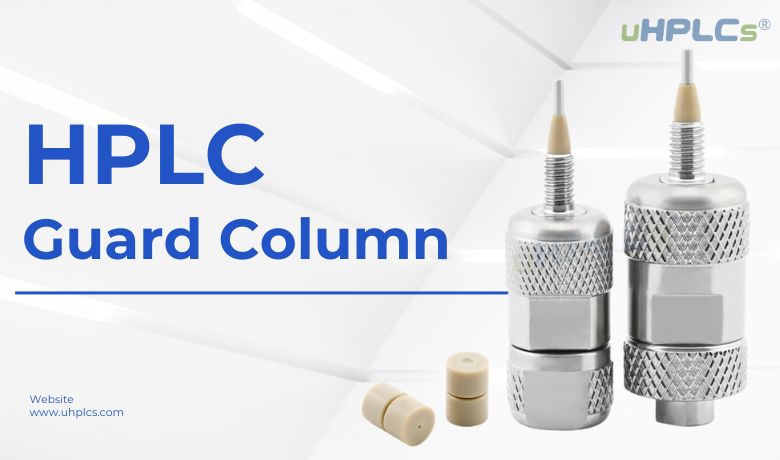
How Does an HPLC Guard Column Work?
An HPLC guard column is installed between the injector and the analytical column. It acts as a sacrificial protective bed that intercepts particulates and retains strongly adsorbed matrix components before they reach the main analytical column. Because the guard cartridge is smaller and easier to replace than the analytical column, it helps reduce contamination, protect the inlet frit and stationary phase, and extend analytical column service life.
This page explains how an HPLC guard column works in that flow path: how the frit and packed bed intercept particles, how the guard stationary phase retains strongly interacting contaminants, and how those mechanisms affect column life and chromatographic performance.
If you need a definition first, see What Is a Guard Column in HPLC?
The Working Principle of an HPLC Guard Column
The working principle of an HPLC guard column is positional and chemical. The cartridge sits in the high-pressure flow path after the injector and before the analytical column. Sample and mobile phase therefore pass through a short packed bed first. That bed is designed to take the first contact with debris and strongly retained matrix components, so the analytical column receives a cleaner stream.
Injector
Guard Column
Analytical Column
Detector
HPLC guard column working principle flow path: injector → guard column → analytical column → detector.
Two protection modes operate at the same time. One is physical interception at the frit and packed bed. The other is chemical retention on the guard stationary phase. A guard column is therefore more than a filter.
Physical Protection
Physical protection is the interception of insoluble material before it reaches the analytical-column inlet. Typical sources include sample particulates, precipitated material formed when a sample diluent mixes with the mobile phase, and debris generated by the LC system. The guard inlet frit and the packed bed capture that material upstream of the analytical column.
If those particles continue into the main column, they can clog the inlet frit, disturb the packed bed, raise backpressure, and degrade peak shape. Intercepting them in a replaceable guard cartridge limits that mechanical damage to a smaller, lower-cost component.
Chemical Protection
Chemical protection comes from the guard stationary phase. Strongly retained contaminants, hydrophobic matrix components, and other compounds that adsorb more strongly than the target analytes can interact with that packing. A portion of that load is retained in the guard bed instead of accumulating at the head of the analytical column.
This is why a guard column is not only a particle filter. An in-line filter can stop solids, but it has no packed chemistry. The guard cartridge function in HPLC includes both particle capture and a limited amount of chromatographic retention. The guard packing should therefore be chemically compatible with the analytical column, not an unrelated material chosen only for hardware fit.
What Happens Inside the Guard Column?
The sequence inside the cartridge is short. Each step is a reason the guard is placed immediately after the injector.
1
Sample enters the guard cartridge
2
Larger particulates are intercepted by the frit
3
The stationary phase retains strongly interacting contaminants
4
Target analytes continue toward the analytical column
5
The analytical column receives a cleaner sample stream
Target analytes still travel through the guard bed. A matched, low-volume cartridge is intended to add protection with as little extra-column volume and extra pressure as the method can accept. It does not remove all contamination, and it does not replace sample preparation.
Particles at the frit
Sample solids and precipitated material are intercepted at the guard inlet frit and packed-bed entrance.
Strong contaminants on the packing
Strongly retained matrix components interact with the guard stationary phase and are held in the sacrificial bed.
Analytes continue downstream
Target compounds pass through the guard cartridge into the analytical column for the intended separation.
How an HPLC guard column protects the analytical column: particles retained at the guard frit, strong contaminants retained by the guard stationary phase, target analytes continue downstream.
Common Sources of HPLC Column Contamination
Guard-column protection is useful because HPLC columns see more than target analytes. The main contamination classes are limited:
- Sample particulates that were not removed by filtration or other sample preparation.
- Precipitates caused by solvent incompatibility when the sample diluent and mobile phase mix.
- Strongly retained matrix components that adsorb at the head of a reversed-phase or other packed bed.
- Debris generated by the LC system, including wear particles from seals or other flow-path components.
A guard column can intercept a share of these loads. It does not replace filtration, compatible diluents, or system maintenance. Those practices still determine how quickly the guard itself becomes contaminated.
Why Should the Guard Phase Match the Analytical Column?
The guard cartridge working principle includes chromatographic retention. If the guard packing is a poor chemical match, it may not retain the same strongly adsorbed contaminants that would otherwise collect on the analytical column. A large mismatch can also add unwanted selectivity, extra volume, or a pressure penalty that the method does not need.
In practice, laboratories usually start with a compatible chemistry rather than an unrelated packing:
| Analytical column | Typically compatible guard chemistry |
|---|---|
| C18 analytical column | Compatible C18 guard |
| C8 analytical column | Compatible C8 guard |
| Phenyl analytical column | Compatible Phenyl guard |
| HILIC analytical column | Compatible HILIC guard |
| SEC column | Compatible SEC guard |
These pairings are starting points, not absolute rules. Mixed-mode methods, specialty phases, and OEM hardware can require a different match. Confirm chemistry, dimensions, and pressure rating for the actual column and method.
Guard column selection should consider:
- Stationary-phase chemistry
- Column internal diameter
- Flow rate
- Pressure compatibility
- Connection volume
- Method compatibility
Select a guard column geometry and internal diameter that are compatible with the analytical column and flow rate while minimizing additional system volume and pressure effects. Do not treat “half the analytical-column ID” as a universal rule. Direct-connect and cartridge-holder formats also change extra-column volume, so the connection style belongs in the same decision as packing chemistry.
How a Guard Column Protects HPLC Performance
The practical result of the HPLC guard column principle is not a guarantee of infinite column life. It is a shift in where contamination lands. The table below compares typical outcomes when the same dirty load reaches the analytical column versus when a matched guard cartridge is installed upstream.
| Without a Guard Column | With a Guard Column |
|---|---|
| Contaminants reach the analytical column | Contaminants are intercepted upstream |
| Inlet frit may clog | Guard frit and guard bed absorb contamination |
| Backpressure may rise | Main column stays cleaner longer |
| Peak shape and efficiency may deteriorate | Analytical performance is better protected |
| Main column replacement is costly | Guard cartridge is easier and less expensive to replace |
A guard column reduces the rate at which the analytical column is fouled. It does not completely eliminate contamination, and a saturated or clogged guard can itself become a source of backpressure or peak distortion. Replacement is part of the method, not an optional accessory step.
Guard Column vs. In-Line Filter: Different Protection Mechanisms
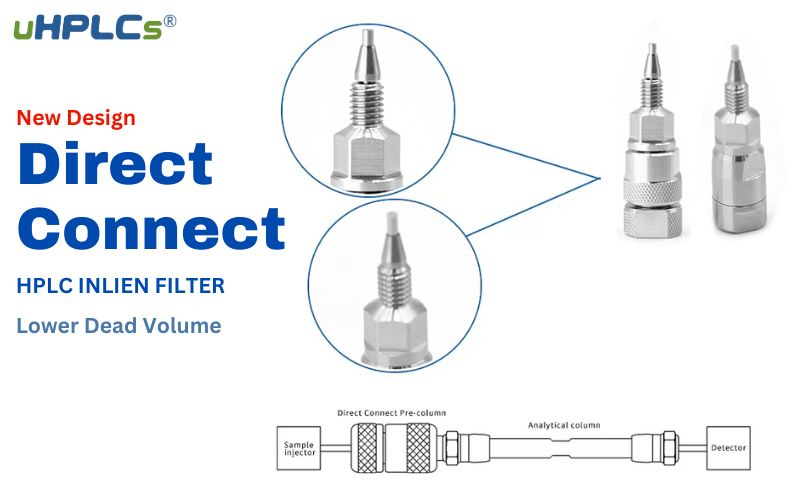
An in-line filter primarily protects against particulate contamination. A porous element captures solids, but it does not contain a packed stationary phase, so it does not retain strongly adsorbed chemical contaminants in the same way.
A guard column provides particulate protection plus stationary-phase-based chemical or matrix protection. That extra packed bed is why phase matching, extra-column volume, and pressure rating matter more for a guard cartridge than for a simple filter.
Use a filter when the main risk is particles. Use a guard column when the sample or matrix can also foul the packing. Some methods use both. For a full comparison, see Guard Column vs. In-Line Filter: Which One Should You Use?
When Should You Replace an HPLC Guard Column?
Replace the guard cartridge when it is no longer protecting the analytical column, or when it has started to affect the chromatogram. Common signals include:
- Unexpected increase in system backpressure
- Deterioration in peak shape
- Loss of column efficiency
- Changes in retention behavior
- Performance improves after bypassing or replacing the guard cartridge
Replacement frequency depends on sample cleanliness, sample matrix, injection frequency, stationary phase and chromatographic conditions. There is no single injection-count interval that applies to every method. If replacing the guard restores pressure and peak shape, the cartridge was doing its job and should be changed on that evidence rather than on a fixed calendar.
How to Select the Right Guard Column
Selection follows the same variables that govern how a guard column works. Keep the list short:
- Match the stationary-phase chemistry
- Choose a compatible internal diameter
- Minimize extra-column and connection volume
- Confirm pressure compatibility
- Select the appropriate cartridge and holder configuration
For available cartridge formats, holders, and column IDs, see HPLC Guard Columns. This page does not replace a full product selection guide; it only states the compatibility checks required by the working principle.
Need Help Choosing the Right HPLC Guard Column?
Choosing the correct guard cartridge depends on your analytical column chemistry, dimensions, flow rate and application. Explore HPLC guard column options or contact our chromatography team for compatibility support.
Frequently Asked Questions About HPLC Guard Columns
What is the main function of a guard column in HPLC?
The main function is to protect the analytical column. The guard cartridge intercepts particulates and retains a portion of strongly adsorbed contaminants before they reach the main packed bed, so the more expensive analytical column stays cleaner for longer.
How does an HPLC guard column protect the analytical column?
It is installed between the injector and the analytical column. The inlet frit and packed bed intercept particles, while the guard stationary phase retains strongly interacting matrix components. Target analytes continue into the analytical column in a cleaner sample stream.
Does a guard column contain stationary phase?
Yes. A typical HPLC guard column contains a short packed bed of stationary phase in addition to an inlet frit. That packing is why a guard column can provide chemical or matrix protection as well as particle interception, unlike an in-line filter.
Should the guard column have the same stationary phase as the analytical column?
Use a chemically compatible packing, often the same chemistry family as the analytical column (for example C18 with C18). Exact identity is a common starting point, not a universal rule. Also confirm internal diameter, flow rate, pressure rating, and connection volume for the method.
How do I know when an HPLC guard column needs replacement?
Watch for rising backpressure, poorer peak shape, loss of efficiency, or retention shifts. If performance improves after bypassing or replacing the cartridge, the guard is likely saturated or clogged. Replacement frequency depends on sample matrix and chromatographic conditions, not a fixed injection count.
What is the difference between an HPLC guard column and an in-line filter?
An in-line filter mainly stops particles. A guard column adds a packed stationary phase, so it can also retain strongly adsorbed chemical contaminants. For a longer comparison, see Guard Column vs. In-Line Filter: Which One Should You Use?